
Sharing Ourselves in Words and Actions:

hurdles

Who are you? Who are we? Who am I?

Three relatively simple questions that all of us can answer. You are . . .; I am Russell Kendall Carter; we are coworkers, family, friends, lovers. All very interesting relationships.

You are someone whom I met in elementary school, and we have been friends for years. I know just about everything about you.

We are coworkers; our group has been together for fifteen years. We work, bitch and moan together, retreat together. And some of us have good outside-of-work, friendly relationships. Our spouses and children also are friends. I am just a simple college professor, aiding my students in their preparations to face the real, cruel world.

It’s as simple as that. WRONG!! – Each one of these relationships is very complex, changing day by day, causing us joy, then grief, then joy . . .

We are individuals with our own unique problems, needs, and desires. We are unique in everyone’s eyes. We are complex individuals, trying to cope with the madness of the world around us. I must tend to my needs before I can even think about helping others. Me and my family are the most important things in my life.

Sound familiar? It should; I hear this every day; from my friends and family, from my ministers, from my students, and from my fellow professors.

We live in a society that insists that the only path to take is one that leads up; up to where? Making it to the top of the heap; what heap? Fame is fleeting, and lasts only minutes; fifteen minutes of fame, then an abrupt drop.

What if we take the time to share ourselves, our true selves, with others, and then we allow them to share their true selves with us. Are we then challenged to step on them on the way to the top? It is very difficult.

In the 1970s, President Jimmy Carter invited the leaders of Israel and Egypt to come to Camp David to show each other pictures of their grandchildren; they did and a delicate peace was declared that lasted until these two leaders either died or were voted out of office. They recognized that they were not enemies, but proud grandfathers.

Can we do the same in our lives? Can we recognize others and people and not obstacles to defeat? We need not fear others; we need to see others as ourselves.




Words and Communion with Others

words

Words and Communion with Others

Words can hurt; words can heal. It is our choice to use the words that heal. By doing less is to go against the norms of traditional society. In the United States, and around the world, we are trained to strike back when something we do not like occurs.

How different would life be if we stopped to think how our reaction affects others – and ourselves.

If we ignore the training that our parents, our teachers, and our coaches have instilled in us, if we lower the me-first instinct that has been instilled in our very essence by our mentors, perhaps we can look at others as equals, not as competitors.

These mentors do not mean to harm us; they are doing what society expects of them and of us.

If we do not respect others, we cannot look at them as people, only objectives to be overcome. For years, I try to have the students in my literature and writing classes to form study teams. I coach them in the advantages that study teams give all students. I stress that we cannot learn in a vacuum. We can only truly learn by sharing.

In studying for my doctorate in literature, I learned how to write properly, taking courses in dissertation writing, poetry writing, short story writing, and novel writing. I was very successful in all courses. Saying this, I truly did not understand how to write until I began teaching it to others. By sharing my knowledge, I had to be as expert as possible.

This holds true for team study also; when we share what we learned with others, we become more expert, and when others share what they learned, they become experts.

Only by seeing each other as equals can we truly share our lives and become better teachers, accounts, lawyers, and yes, even politicians. When we respect others for theirs views and needs, we become a better society.

Words in communion with others uplift everyone.

Public transit in Vancouver

An enjoyable time on public transit.

For the last two days of our anniversary vacation, Linda and I have traveled by the public bus routes throughout much of Vancouver. This has been a truly wonderful experience. For $1.75 per person, we were able to travel to any area in the greater Vancouver area. These busses were driven by electric overhead wires; all electric, which adds to Vancouver’s desire to be the most green city in the world by 2020.

On Tuesday, June 13, we travelled to the Vancouver Aquarium. This is not my favorite activity, but it is ranked as one of the highlights of Vancouver. As aquariums go, it was a nice experience. The aquarium was filled with people, many school groups, and a service staff that is very pleasant. The aquarium itself was very clean in all areas, including the restrooms and the food courts. Some of the students, especially the boys, were sometimes loud and boisterous, but were respectful of others, meaning they did not obstruct anyone from viewing nature’s beauty.

On Wednesday, we traveled to the University of British Columbia to visit the Museum of Anthropology. This was absolutely fantastic, showing art, tools, and clothing from the many cultures of the indigenous peoples of the world. This was one museum that I truly enjoyed; I could have stayed much longer than we did. We missed the connecting bus to bring us to the city hub just outside the campus. Rather than wait a half hour for the next, we decided to walk through the campus to the hub; about a 20-minute walk.

We wondered at the diversity of the University and the obvious impact of the types of natural sciences the school offers. I was very thrilled by the diversity of the students. They represented all colors, all nationalities, and all age groups; and, they interacted beautifully; there was a feeling of close congeniality.  Although, they did seem to stick with their ethnicities.

On the bus ride returning to our hotel area, there were a group of eight high school girls who were with us on the bus. These were the typical and universal mid-teen girls; they were dressed in skin-tight genes, purchased with many holes in the knees and legs. They all had lots of silver (braces) in their mouths; and they giggled and closed ranks with whispered secrets that brought on more giggling. It was an interesting bus trip. However, they all displayed a delightful respect for elders. Every time an elderly person entered the bus, they gave up their seats so that the person could be seated, rather than be forced to stand. Watching the respect these students showed their elders was impressive and a delight to see. I am ashamed to admit that the students I see in the United States are too spoiled to offer the same respect to their elders.

The parents, teachers, and other mentors are to be congratulated for a proper upbringing of these students. I pray that we can do the same.

Glacial Lakes and Majestic Mountains (leaving the Rockies)

glacial lake

As I am watching the scenery pass by my train window upon leaving Kamloops, British Columbia I am truly amazed at the regal nature that God has given us, if we take the time to really look to appreciate it. Smooth-as-glass lakes sometimes appear as perfect ice skating rinks. These glacial lakes are fed by rivers that are, many times, torrents of water propelled by the snow melts from the mountains.

The wonder of the rapids of the river and the smoothness of the lakes never ceases to amaze me. I was born and raised as an inner-city denizen whose experience with nature was the urban rat; not a regal animal. Even when moved to the suburbs in my early teens, I rarely, if ever, really experienced the beauty of God’s pristine valleys and highlands.

My wife and I are celebrating our 50th wedding anniversary this summer and decided to celebrate it early by flying to Alaska for a cruise, then enjoy a ten-day train ride through the Canadian Rockies. This is a 23- day forced relaxation for both of us, a most unusual event. We have never taken a vacation longer than a week, usually only a three-day getaway.

My passion has always been to photograph the birds and jets that pass by our hotel patio at Virginia Beach, or the birds, deer and sheep in our rare visits to Skyline Drive in Virginia.

I am always most satisfied with these minor pauses in our daily routines, routines that are not full-time jobs, but full-time volunteer assignments for my wife and part-time teaching and full-time spiritually shared prayer with my fellow congregants. This 23-day tour of Alaska and Canada has convinced me that by not taking the time to appreciate the beauty of God’s Earth, I am short-changing myself by working at my chosen trades so much that I do not take the time to both appreciate and glorify the grandness of God’s world.

I am disappointed and appalled at the lack of compassion for the Earth that our political leaders have. Mankind has been raping the Earth of its natural wonder with little regard for future generations. Small mindedness and lack of foresight leads us down the path of assured final destruction, due to a lack of all natural or man-made necessities, such as food and clothing. We are all concerned with the life of our grandchildren, but how many of us are truly concerned with the life of our grandchildren’s grandchildren? We will never know them, so why must we think if them? Who cares . . . but, who should care?

That is a very difficult question to ask. All too often we take the stand that basically goes like this: “I have worked all my life and it is time to enjoy the fruits of my labor.” I agree; but let’s not destroy what we have without concern for our future generations. We do not have to consume it all. We do not have to ignore expanded technology that will alleviate our passion of destroying or raping Earth.

glacial lake

Liquid Sunshine

Liquid Sunshine.jpg

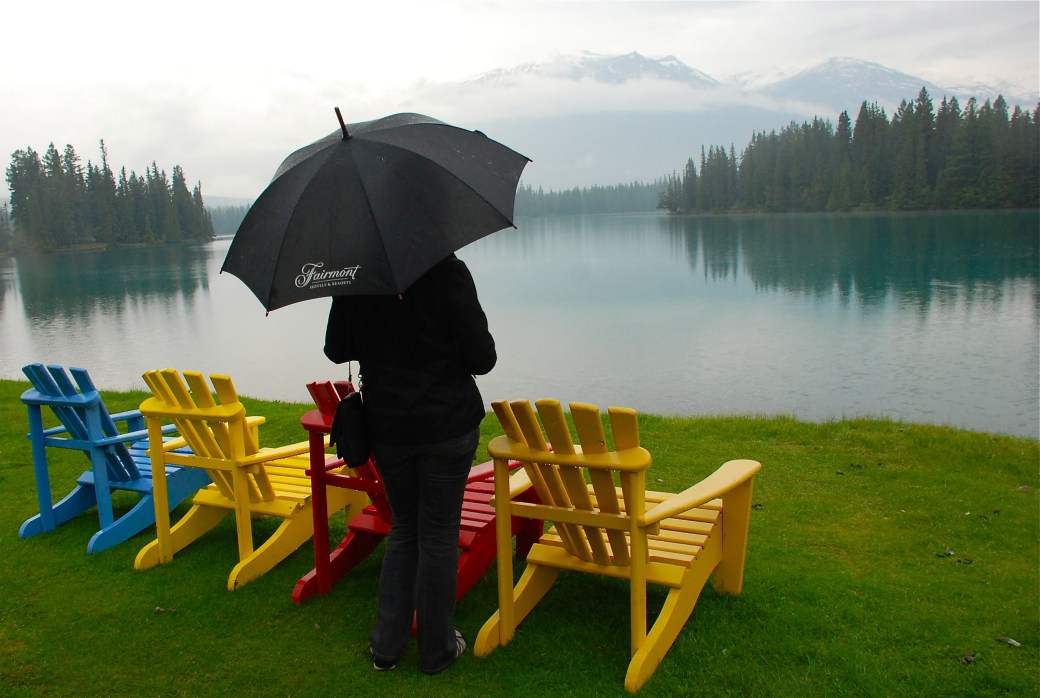
A washout! That is what this Saturday in Jasper, Alberta is. A complete and total washout! People tell us that it will stop raining after lunch. My only comment is “SO WHAT!” We are in the final days of our 24-day 50th anniversary vacation in Alaska, on a cruise, and touring the Canadian Rockies on the Rocky Mountaineer, with only two days of rain during this entire trip. What a blessing God has given us on this trip.

I have met and talked with people from England, Canada, Japan, China, Indonesia, Taiwan, Scotland, Ireland, Nova Scotia, Newfoundland, Australia, New Zealand, Alaska, and the United States.

All of us are enjoying our various holidays in Canada and Alaska. I have exchanged emails with several people, making friends from many of these countries.

The people who are tending to all our needs are also from many areas of the world: Indonesia, Serbia, Australia, and New Zealand, and, of course, Canada. Many are students on summer jobs. The others began as students, finished their studies, and stayed to glory in the beauty of Canada and Alaska.

Friends . . . We are truly all the same; we have the same desires, the same ailments, the same needs, and if given the chance, the same desire to meet and greet each other as equals. For all our differences, we are knit together in one body of humanity.  We are made one people; a unity of diversity; diversity within unity.

What does all this have to do with liquid sunshine? It has given me the chance to reflect. As my wife and I were having breakfast in the Orso restaurant in the Fairmont Lodge in Jasper, I was watching the rain increase out our window viewing the lake. Second to watching waves exploding ashore in Virginia Beach, watching the rain ripple the glassy surface of a river-fed lake is a time for being very pensive.

And, since I am a people watcher wherever I go, my thoughts fell to how alike we all are, and how different we are.

Unfortunately, we always seem to emphasize our differences, not our similarities. Pity us. Is this really the way the world should work? Notice I used the verb should, not the verb is.

I am a news hound. I love listening to the good news; I love listening to the no-so-good news. I also love listening to the constant bickering of our political leaders as they parse their words to let us know absolutely nothing about what they are doing for . . . themselves!

But, through this all, I refuse to look at the people I hear about on the news as the other. I look at them as us. We all have relatives whom we love; we have relatives that are hard to get along with; we have relatives who are, well, a little different. We can fill in our own meanings for a little different. We may not profess our love for these relatives, but we certainly do not wish them harm, or undo hardships. Then why do we not accept these same people who are not our family relatives? Then why do we treat them as the other, when in fact, they are us?

It has taken me some time to mature to this level of acceptance, a fact that I am not overly proud of. But, since I have altered my thinking, I am less tense, without headaches, and, by all means, happier. And, my friends have noticed, asking if I have changed something in my life.

I say “Yes, I have.”

Stillness

rowboat

I am a workaholic; my first job was selling the Newark Evening News in front of the Ampere train station in East Orange, New Jersey. I was a 9-year-old at the time. I lied about my age; the News would not hire anyone under ten, but I was big for my age, so I began working early. At the age of eleven, I was given the opportunity to have a paper route. The News gave me twenty-five customers; I quickly sought others and within six months, I had a paper route of 125 daily and 75 Sunday papers. When I doubled what the News gave me, I won a bicycle; my first one. I have worked ever since.

Presently, my wife and I are on a three-week vacation in Alaska and Western Canada. At first, I was very apprehensive, which was very quickly followed by a feeling of extreme unrest, perhaps even boredom. We are now in our stateroom on the Noordam in Ketchikan, Alaska harbor; it is raining. The rain should clear within the hour, so we will venture into the town shortly.

Watching the small boats go by our window, coupled with the slow movement of the tidal waters, I am, for the first time, settled into a period of stillness and quiet. For one of the first times in my life, I am truly settled and comfortable with the fact that I will basically do nothing except enjoy the day with my wife.

We would spend weekends in Virginia Beach, watching and listening to the ocean tides crashing to the shoreline, which is relaxing, but I always knew that when I returned home, I would have papers to grade. Earlier, when we would vacation on Cape Cod with our children, I enjoyed the week, but my mind was always on my business back in Summit New Jersey. Was everything going smoothly; was my manager able to handle any difficulties; questions, such as these, would haunt my serenity, or, lack of serenity.

With this three-week vacation, I am forced to truly let down to a true stillness. During this cruise, we have spent two days just cruising from place to place. Fortunately, the seas have been calm, and being able to sit on our veranda, read, write, and relax has been a true catharsis.

This causes me to reflect on why we all need to get away from our everyday jobs to truly relax, to enjoy a week, a weekend, a day, or even an hour or two, when we can find the stillness within us, to clarify our minds, to process confusing emotions, to reflect on our experiences, and to give artistic expression to why we are living.

Give this a try. It has taken me 74 years to get to this understanding as to why we need to leave our stress behind, find our place of stillness, and regenerate our inner selves. I pray that others will discover this sooner.

Dirt Poor

dirt poor

I have a question for us to answer; why do we rarely take the time to stop and to think!!!

You and I know, or think we know, where we will be in 10 or 20 years. Many students in the lower financial tiers have no idea where they will be next week, much less in 10 or 20 years.

Think about whether we should always take, take, take; and give nothing in return. There are those of us who do try to give back for all we have been given, but perhaps we do not respond as we should.

Every day in my literature classes, I am confronted by students who come from upper middle-class families with many children; these parents send their children to community colleges for the first two years and then on to prestigious schools, such as JMU or UVA. I also have many military veterans returning to school under the GI Bill, who recognize that there is something better for their futures, if they work for it.

Most of my students struggle . . . really struggle, many times waiting until mid-semester to buy books because their loan money is slow in coming to them. Some professors penalize these students because they are slow in completing assignments, assignments they cannot complete due to insufficient course materials. This is no way to run an educational system in any state, much less in a wealthy state, such as Virginia.

Unfortunately, I have no surefire responses to this problem. What I do have is my personal dedication to my students, a dedication that is designed to assisted these financially-challenged students in completing their assignments.

Most, if not all, material that is studied in the first two years of college is available on line. But, even if they are computer savvy, these students have no idea where to find it. I believe that professors, such as myself, should be willing to provide links to the early materials in the course to allow these struggling students to succeed. This is an extra and time-consuming resource that professors should take the time to provide with their syllabi.

This is an unforgiving country that we live in today. Very few are willing to truly give what we think we cannot do without. Unfortunately, and ashamedly, my generation has perfected this culture of greed. I pray that these students, when they attain even a faction of local leadership, think about the financially-challenged students and give them a leg up, helping them unlike the way our world does not.

Fable of Easter Bunnies and Chocolate Labs

easter lab

There are times in our lives, when we will suffer for what we have done.

This is difficult to accept and more difficult to absorb.  Too often, we feel that we are punished for no reason at all, particularly when we are doing something nice for another person.

On Good Friday night, I was returning after serving at church; I spoke with my wife, Linda, telling her to pour the wine. It was about 8:45. When I exited my car, my wife called me from the middle of the front lawn. I didn’t see her at first, due to the darkness. In other words, I was listening to my inner voice, ignoring what was happening around me.

When I became aware of the situation, I saw Linda sitting on the lawn with my daughter’s Chocolate Lab by her side. She could not get up; she immediately told me that we had to go to the hospital, because she thought she broke her arm. She did!

After a week of dancing around emergency rooms and inattentive appointment personnel, we saw an orthopedic surgeon, and she had a plate placed in her arm to stabilize her seriously damaged elbow. She is recovering nicely, except for the discomfort and itching that goes along with having a splint from her shoulder to her wrist. Aloe and Betadine seems to have calmed the itch temporarily.

This is not the punishment that I mention; the true punishment is the lack of mobility. Linda cannot drive; she cannot continue leading the volunteers at The Table at St. George’s, the feeding ministry that she leads. Wonder Woman has been sidelined due to injuries. The disappointment and frustration is the punishment Linda is realizing; and for what? Walking our daughter’s Lab, that we were watching for the weekend?

John Belushi used to say that Life is a bitch and then you die. How and why is it necessary for people, such as Linda, to suffer for doing a good deed? God seems to be punishing her for being a good mother.

We cannot know the answer to this. However, I look at this as a partial blessing. I have been praying that Linda step back from the grueling leadership position at the feeding ministry and let others do the long tedious minute-by-minute planning and adjusting the layout as the market day unfolds.

With this unfortunate broken elbow and our 50th anniversary trip to Alaska and Western Canada later this month, Linda will have been sidelined for over two months. Perhaps, when she returns to The Table, she will let others do the tedious work, while she begins to spend more time planning for the future of feeding our neighbors.

I doubt this seriously; Wonder Woman never quits. Secretly, I am very happy about this. We are both in our 70s; keeping busy, serving others, and doing God’s work is a blessing that keeps both of us young and healthy.

Even if we can’t keep pace with a hundred-pound Lab chasing an Easter Bunny.

God bless!


Dreams: God has not abandoned us.

follow dreams

I offered a little piece of advice to the academic scholars of Germanna Community College last evening. I talked about the inner voice that sometimes plagues us, but always speaks to us.

This is the crux of what I said: “listen to your inner voice; it’s smarter than you are, it’s smarter than your parents, or your professors. It knows YOU!!!”

How does this inner voice relate to dreams? In my world – in every way. The inner voice recognizes what your true dreams are; it is not always urging you to an easy path.

During my long career in photography, I was very unhappy; now, there are many reason why this was so, but the main reason was I was too timid to go after what I really wanted. I spent a good portion of my career, behind the counter of a camera store, teaching people how to use their cameras; teaching people how to use natural lighting to improve their portraits; teaching people how to believe in themselves when taking more than just snapshots.

I also spent many, many years teaching Sunday school at Christ Church in Summit, New Jersey. Allowing my middle and high school students to investigate what their own relationship to God is and how this relationship governs their deepest dreams, and how to achieve them.

After a near-fatal car accident, God took over and by using many very good friends, at the age of 54, I began teaching in New Jersey, and am now a literature professor at Germanna Community College. With my students, I explore what classic literature and modern day truths affect their personal dreams.

Parents, educators, and politicians are continually telling young people to settle for whatever they can get to be happy; the world is just too “iffy” to try for the brass ring of true happiness.

NO! NO! not true. It may be more difficult to snatch happiness from the garbage heap we call our present lifestyle; but dreams are still attainable. God has not abandoned us. God is there to support us as we struggle to make our dreams come true. It may be difficult at times, but if it is truly worth the effort, you will be rewarded.

IF IT IS TRULY WORTH THE EFFORT, YOU WILL BE REWARDED.

Ambiguity and Vacuity

Source: Ambiguity and Vacuity